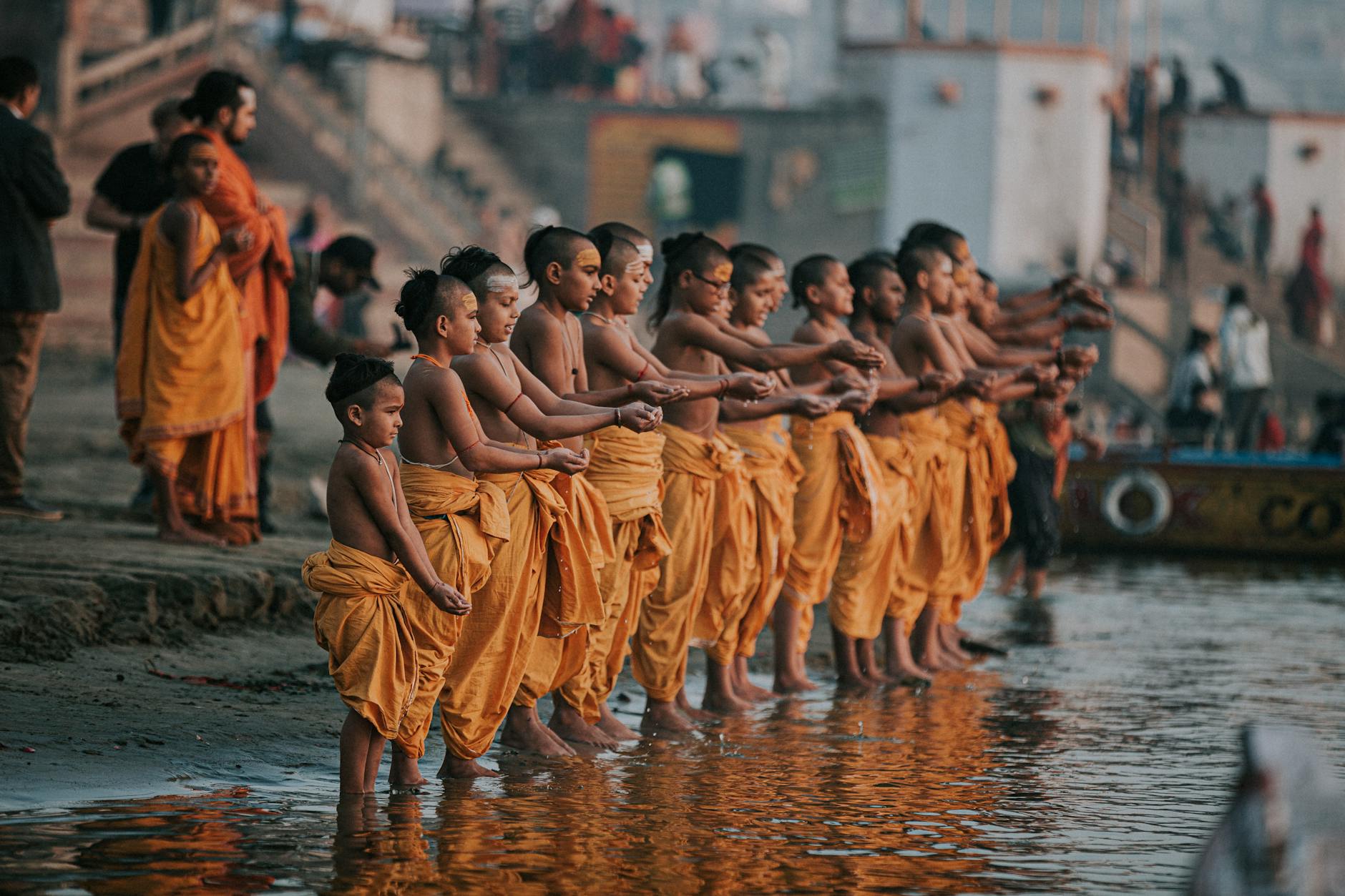
What if you didn't just visit India—but lived some of its most sacred traditions?
Imagine waking before the city. It is still early when you step into a boat on the Ganges in Varanasi. Along the riverbanks, pilgrims are already gathering at the ghats. Some enter the sacred water. Others pray beside the river. Ancient rituals continue as the city slowly comes to life around you. And you are there, watching it from the Ganges.
The evening before, you experienced this same river completely differently. As daylight faded, you watched the ghats fill with people and witnessed the Ganga Aarti, surrounded by prayer, ceremony and the movement of one of India's most sacred cities.
But Varanasi is only one chapter. Your journey continues to Bodhgaya, to the place where Siddhartha Gautama attained enlightenment beneath the Bodhi tree. You enter the Mahabodhi Temple and spend two days in one of the most important Buddhist pilgrimage destinations in the world.
Then you fly north. The landscape changes as you arrive near the Himalayan foothills and continue to Rishikesh, where three nights beside the Ganges allow you to do something very different from simply sightseeing. Here, you participate. Practice yoga and meditation beside the river. Enter the sacred Ganges. Offer water to the Sun and Shiva. Place flowers and candlelight upon the river. Visit ashrams and, when available, encounter gurus during their readings or ceremonies. Experience Aarti at Triveni Ghat and another ceremony at Parmarth Ashram.
And before all of this, India introduces you to another part of its story: Delhi, a Hawan ceremony in Agra, and the moment you finally stand before the white marble of the Taj Mahal.
This is not a journey where you only stand outside and observe India. You sit beside its river. You enter its temples. You witness its ceremonies. You practice beside the Ganges. You walk through places connected to the history of Buddhism. And twelve days later, you may leave with a very different understanding of why these places have drawn seekers and pilgrims for centuries.
Delhi → Agra → Varanasi → Bodhgaya → Rishikesh
This is the Sacred Heart of India.
Itinerary
The Golden Triangle with Sacred Sites — Delhi – Agra – Varanasi – Bodhgaya – Rishikesh – Delhi
Arrival in Delhi
Your Journey Begins With a Blessing
You arrive in India, collect your luggage and walk through the arrivals terminal. Outside, Delhi is waiting.
On the way to your hotel, begin taking in your first impressions of the capital—a city where contemporary India moves alongside buildings and monuments that carry the memory of another time.
But your first experience in India is not simply sightseeing. Your journey begins with Aarti. Stand before the ceremony as your journey receives its first blessing, then receive a traditional tika on your forehead—a ritual used in India when beginning a journey or something new.
Before you have seen the Taj Mahal or reached the Ganges, India has already welcomed you into one of its traditions. Tonight, you sleep in Delhi. Tomorrow, you begin discovering it.
Delhi
Step Into the Many Worlds of India
Wake up in India and step into a capital where different histories, religions and traditions exist side by side.
Move through Old Delhi before standing at Raj Ghat, the memorial to Mahatma Gandhi. Then watch the city change as you travel into New Delhi, through the government district surrounding Rashtrapati Bhavan and Parliament, past India Gate and the Salt March Memorial.
Later, enter Bangla Sahib. The movement of Delhi gives way to the atmosphere of one of the city's important Sikh temples. Your day concludes at Swaminarayan Akshardham, surrounded by the architecture and craftsmanship of its Hindu temple complex.
One day in Delhi, and you have already begun to see why India cannot be understood through a single monument, religion or moment.
Delhi to Agra
Leave the Capital Behind
After breakfast, the streets of Delhi begin to disappear behind you as you travel toward Agra.
This city is known around the world for one extraordinary monument—but today you meet Agra before meeting the Taj Mahal. Visit the work of Mother Teresa, then walk through the traditional markets of Old Agra.
Tomorrow you will stand before one of the most famous buildings in the world. But tonight, you are already there—in the city that has been waiting behind all those photographs.
Agra
Begin With Fire. End Before the Taj Mahal.
Your morning begins around the sacred fire of a Hawan ceremony. You experience a Hindu ritual that the program describes as a practice intended to bring positive energy into the body and release negative energy.
And then comes the moment so many travelers imagine before coming to India. You approach the Taj Mahal. The white marble appears before you. Walk closer and begin noticing what photographs cannot fully show—the symmetry, the carved details, the domes and the craftsmanship of a monument that took 22 years to build. Shah Jahan created it in memory of Mumtaz Mahal. Centuries later, you are standing in front of it.
This is no longer an image of India. You are here.
The Taj Mahal is closed on Fridays.
Agra to Varanasi
Tonight, You Meet the Ganges
Today the journey carries you toward a completely different India. You arrive in Varanasi, the sacred city of the Ganges.
As evening approaches, make your way toward the river and step aboard a boat. From the water, watch the ghats come alive. Pilgrims gather along the river. Sacred bathing and purification rituals unfold before you. More people arrive as the evening ceremony approaches. And then the Ganga Aarti begins.
You are not watching it on a screen or looking at a photograph. You are on the Ganges, in Varanasi, while one of the city's most important rituals unfolds along its banks.
Afterward, continue among the ghats by rickshaw. Tomorrow, before the city fully awakens, you will return to this same river.
Varanasi
Wake Before the City
Your day begins early. Step into a boat and return to the Ganges as Varanasi begins another morning. From the river, watch pilgrims enter the sacred water and worship along the ghats. Pass the ritual bathing areas and the cremation sites that have made this riverfront one of the most profound places in Hindu tradition.
Then leave the boat behind and enter the narrow lanes of Old Varanasi. Here, religion is not something separated from everyday life. You see it woven into the streets and the rhythms of the people who live here.
But the day is not finished. Later, travel to Sarnath. You have spent the morning surrounded by Hindu traditions; now you stand in the place where Buddha gave his first sermon. Walk among the ruins and visit the stupa, Buddhist temple and museum.
One morning on the sacred Ganges. One afternoon where Buddhist teaching began to spread. And tomorrow, that Buddhist path takes you even farther.
Varanasi to Bodhgaya
Stand Where Buddha Attained Enlightenment
Leave Varanasi and travel by road toward Bodhgaya. Approximately six hours later, you arrive at one of the most sacred Buddhist pilgrimage destinations in the world. This is the place where Siddhartha Gautama attained enlightenment beneath the Bodhi tree.
During your two days here, enter the Mahabodhi Temple and visit other temples in Bodhgaya. Think about the journey you have just made. Only yesterday, you were moving through the ghats and narrow streets of Varanasi. Now you are standing in a place that has drawn Buddhist pilgrims from around the world because of what happened here.
There is no need to rush this part of the journey. You have two days to experience Bodhgaya.
Bodhgaya to Rishikesh (via Dehradun)
Now, You Become Part of the Experience
After breakfast, leave Bodhgaya and fly via Delhi to Dehradun. From the airport, continue approximately 45 minutes to Rishikesh.
The scheduled routing shown by the operator is Bodhgaya/Gaya → Delhi → Dehradun and is subject to airline availability and schedule changes.
And here, the journey changes. You have watched rituals. You have entered temples. You have stood beside sacred places. In Rishikesh, you begin to participate. For three nights, the Ganges becomes part of your own experience.
Practice yoga and meditation beside the river. Enter the sacred Ganges as described in the program. Participate in the ritual of offering water to the Sun and Shiva. And then take a candle with flowers to the river. Imagine holding it for a moment before offering it to the Ganges.
Visit local ashrams and, depending on availability, encounter gurus during their readings or Aarti ceremonies. As evening comes, join the Ganga Aarti at Triveni Ghat, where the program describes the ceremony continuing through song and dance. On another day, experience Aarti at Parmarth Ashram. Visit Ram Jhula and walk through Rishikesh's traditional markets.
You first encountered the Ganges in Varanasi, watching from a boat as ancient rituals unfolded along its ghats. Now you meet the same river again at the Himalayan foothills. But this time, you are not only watching. You are practicing beside it. You are entering it. You are making an offering to it.
Three nights in Rishikesh give you time to experience this part of India rather than simply pass through it.
Rishikesh to Delhi
What Will You Take Home?
After breakfast, it is time to leave Rishikesh and travel by road toward Delhi in time for your international flight.
Twelve days ago, you arrived in India and began your journey with an Aarti and a tika. Since then, you have stood before the Taj Mahal. You have watched evening prayers from the Ganges in Varanasi and returned to the river before the city awakened. You have walked through Sarnath. You have reached Bodhgaya and the place where Buddha attained enlightenment. And in Rishikesh, you did more than observe—you practiced yoga and meditation beside the Ganges, entered its sacred waters and experienced its ceremonies.
Now the road carries you back toward Delhi. You are leaving India. But perhaps the more important question is:
What part of India are you taking home with you?
Planned Hotels
| City | Nights | Hotels |
|---|---|---|
| Delhi | 02 | Radisson Blu Dwarka or similar |
| Agra | 02 | Royal Sarovar or similar |
| Varanasi | 02 | Om Vilas or similar |
| Bodhgaya | 02 | Marasa Sarovar or similar |
| Rishikesh | 03 | Vasundhara Palace or similar |
Note: Hotels are subject to availability. If a proposed hotel is unavailable, accommodation of the same category will be provided.
What's Included
- 11 nights accommodation in proposed hotels or similar
- Daily breakfast throughout the journey
- Airport assistance, traditional welcome & transfers
- Private luxury transportation with driver
- All entrance fees according to the itinerary
- Spanish-speaking guide
- 24/7 Spanish-speaking assistance
- Daily bottled mineral water
- Rickshaw experience
- One dinner with traditional Indian dances
- Indian cooking class
- Visit and interaction with a Hindu family
- Village visit as specified by the operator
- All applicable taxes and tolls
What's Not Included
- • Beverages other than those specified in the itinerary
- • Excess baggage charges
- • Porterage and tips at hotels and airports
- • Personal expenses not included in the program
- • Expenses resulting from cancellations or circumstances beyond the operator's control
Things to Keep in Mind
- • The Taj Mahal is closed on Fridays.
- • Swaminarayan Akshardham Temple is closed on Mondays.
- • The Ganges boat ride may be cancelled if river conditions do not permit safe operation.
- • Hotels shown are proposed and subject to availability; similar-category hotels may be substituted.
- • Hotel classifications are based on Indian standards.
- • Standard hotel check-in is 2:00 PM and check-out is 12:00 PM.
- • Flight schedules are subject to airline availability, modification or cancellation.
- • Additional services outside the program are paid directly by the traveler.
- • Driving times are approximate and may change depending on road conditions.
Visa Information
Travelers are responsible for obtaining the appropriate visa for India. Visa requirements and processing times can change, so travelers should verify the current requirements before travel and apply only through the official Government of India e-Visa website.